







































ADVENDURE is the leading web portal in Greece about Mountain Running, Adventure, Endurance and other Mountain Sports
info@advendure.com



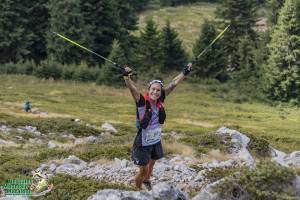
2026 kicks off powerfully in our editorial line-up, with a remarkable professional athlete taking the lead: German trail runner Rosanna Buchauer, a member of the international Dynafit trail running team. Rosanna has claimed major victories in races such as the Lavaredo Ultra Trail and the Grossglockner Ultra Trail, and has also reached the podium in top events like the UTMB®-CCC and the Chianti Ultra Trail by UTMB®.
In addition, Rosanna is active as a keynote speaker, sharing her knowledge and experience in trail running and ultra-distance racing at major international events. During one of her talks — which deeply inspired us when we attended it in October at Dynafit’s headquarters in Kiefersfelden, during the Dynafit International Press Camp — we had the idea to ask her to write an exclusive article for Advendure readers.
The topic? Mental strength, training the mind, and the valuable lessons one can learn from challenges and setbacks in racing.
Rosanna gladly accepted and wrote an inspiring article, which we are proud to publish today. We warmly thank her — as well as Dynafit — for their contribution to our editorial content!

Covered in sweat. A desperate smile on my face. A tired body. Legs that want to stop.
And still, I keep going.
Everything inside me screams, “stop, lie down.” But I don’t.
Why? And how?
Ultra running has taught me more about the human mind than any textbook ever could. This is not a story about mastering the body over the mind — it’s about learning to move with it.
“So you’ve seen me at my limit,” I often begin my keynotes, showing photos from finish lines of 100-kilometer races. Battled. Sweaty. Glowing.
“That is exactly what ultra running is.”
That glow isn’t about winning. It’s the glow of impressing yourself — of discovering strength you didn’t know you had.
I am a professional international trail runner, and I believe the key to progressing from leisure running to professional sport is not talent alone, but the mind. Yes, I also had some luck in my genes. But at many starting lines, I’m not the physically fittest athlete — and still I find myself on podiums.
Through racing the toughest ultra-distance mountain races in the world — and through painful failures — I’ve learned to train mental strength like any other skill. With structure. With intention. With a mental coach. Not as motivation, but as preparation.
An ARTE documentary that followed my preparation and racing around Mont Blanc later showed scientifically what I had learned through experience: when distances become extreme, the mind plays a decisive role in what the body can sustain.

Ultra running is not pretty — and that is the whole point
Ultra running is not beautiful Instagram running. It’s not a 10-kilometer run in the park.
It can be 120 kilometers. Six thousand meters of elevation. Running, hiking, crawling. No mobile signal. No people around. Cold, wet. Slipping on ice. Falling into rivers.
And not stopping.
What keeps me moving then is not fitness alone. It is the mind.
Ultra races are more than a sport. They are pure emotion — raw and unfiltered. And that rawness is why spectators react so strongly. They cheer when runners look broken, hollow-eyed, almost unrecognizable.
For a long time, I asked myself why.
I suffer. I look like I’m dying.
And people feel inspired?
The answer is simple, yet uncomfortable: because in everyday life, we rarely allow ourselves to be real. We dress up for meetings, put on makeup for dinner, say “I’m fine” when we’re not.
In an ultra, there is no energy left for masks. All that remains is movement, survival, honesty.
It’s not the win that matters most.
It’s the fight.
Going all in.
Showing your real face.
Mental strength is not dominating your body; it is staying present when there is nowhere to hide.

When the mind carries you — and when it breaks you
I’ve pushed my body to places many people will never experience:
Six thousand meters of ascent in one day.
Altitudes close to 6,000 meters in Bhutan.
Hallucinating — yet still moving toward the next night camp, food, and shelter.
But I’m certain: my body alone didn’t get me there.
My biggest asset is my mental strength. My mind.
That mindset — run with your mind — is central to everything I do. The body executes. The mind decides whether execution continues.
But this power comes with responsibility. And I learned that the hard way.
After major successes, I entered a long phase of overload. Too many races. Too little sleep. Emotional and physical stress on top of training. Pain in my foot that I ignored.
Looking back, I thought I could handle everything. I thought I had to prove myself.
I didn’t listen.
Halfway through what is probably the biggest race in trail running, the Ultra-Trail du Mont Blanc, my tendon ripped. The race was over. What followed were crutches, weeks barely able to walk one kilometer a day, and long, lonely hours on the indoor bike.
One kilometer is nothing.
You can’t even go to the bakery.
The breakdown wasn’t sudden. It was months of accumulated stress and denial. My mind — once my greatest ally — had turned against me.
I wanted to be tough. I ended up broken.
Without training, without rhythm, I questioned my identity.
Who am I if I don’t run?

Training the mind
Recovery forced reflection. I began working intensively with a sports psychologist and learned to treat the mind not as something mystical, but as a tool — trainable and steerable.
One concept I used and further developed with my mental coach changed everything: imagine your mind as a room.
You fill it with voices, like people in a meeting. Some voices support you: the fighter, the calm problem-solver, the inner friend. Others are harsh: doubt, fear, expectations, the voice saying you are not enough.
The key learning here is that you don’t control which thoughts appear — but you do control which voices you invite to speak and which you ask to leave.
Thoughts come and go.
You decide who gets the microphone.
This understanding carried me back to Chamonix — to the race I had once failed. One year later, healthy in body and mind, I stood at the same starting line.
And this time, I finished. It was still one of my proudest finish lines.

Discomfort is not failure
One of my most practical mental tools is how I reframe pain: discomfort is a warning signal — not a breakdown.
I compare it to a car dashboard. An orange light means something is off: low fuel, overheating. Pay attention — but you’re not in immediate danger. A red light means stop.
In ultra running, learning this difference is essential.
Sore muscles, exhaustion, hunger — orange lights.
A ripped tendon, loss of coordination — red.
Mental strength means not panicking at orange lights — and never ignoring red ones.
This applies far beyond sport.

My life — and our stories — aren’t written in a straight line
My story doesn’t end in a perfect upward curve.
The 2025 season was a mix of strong races, failed mountain projects, and risks that didn’t pay off. I tried 100-mile races, world championships, ambitious goals. Some worked. Many didn’t.
If you only look at numbers, I failed. But — and this “but” means a lot to me — I put myself in the mix. I tried.
Alongside disappointment were moments of deep happiness: a home “race” organized by my five-year-old nephew, training camps filled with gratitude, quality time with friends after tough training sessions.
Mental strength has many faces. It’s not constant winning.
It’s resilience, curiosity, and growth.

My 5 key learnings to take with you
If you read this far and take anything from it, let it be this:
In sport. And in life.
Run — or walk, or fly (you decide) — with your mind.
You might be surprised where it takes you.
Rosanna Buchauer
Photo copyright: Carsten Beier, www.sportshot.de, WMTRC, Dynafiit, Jan Lenfert, David Herzig








ADVENDURE is the leading web portal in Greece about Mountain Running, Adventure, Endurance and other Mountain Sports
info@advendure.com